-
 8613931787312
 -
 Botou Industrial Zone on the east side of National Highway 104, Botou City, Hebei Province


Understanding Resistance Welding Equipment: Cost, Technology, and Industry Leaders
Resistance welding has become a staple in manufacturing, especially in industries like automotive, aerospace, and electronics, where speed, consistency, and strength are essential. As this demand grows, so does the need to understand the technology behind resistance welding equipment, the factors influencing the resistance welding machine price, and how to choose the right resistance welding equipment manufacturers for your business.
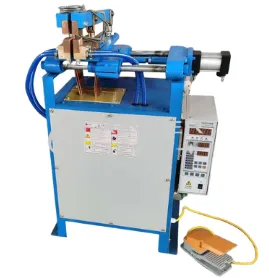
In this article, we’ll explore the key aspects of resistance welding systems, pricing considerations, and how to identify a reliable resistance welder for industrial needs.
What Is Resistance Welding Equipment?
Resistance welding equipment is designed to join two or more metal parts by applying pressure and passing a strong electrical current through the contact point. This creates localized heat that fuses the metals together without the need for filler material.
There are several types of resistance welding equipment, including:
Spot welders
Seam welders
Projection welders
Butt welders
Each type is suited for different materials, thicknesses, and joint configurations. A basic resistance welder setup includes a power source, control unit, electrodes, and a mechanical system for applying force. The simplicity, speed, and repeatability of this method make it ideal for mass production.
Key Benefits:
No consumables (like filler wire or gas)
Fast cycle times
Clean, automated process
High-quality, repeatable welds
Because it doesn’t require open flames or toxic gases, resistance welding equipment is also considered safer and more environmentally friendly than many other joining methods.
How Much Does Resistance Welding Equipment Cost?
When evaluating resistance welding machine price, there’s no one-size-fits-all answer. Prices can vary significantly depending on the machine’s size, type, automation level, and manufacturer.
Entry-Level Equipment:
Basic benchtop resistance welders for light-duty or lab use may start around $2,000 to $5,000. These machines are suitable for small-scale production, testing, or prototyping.
Mid-Range Machines:
For industrial-grade spot welding systems capable of medium-volume output, the resistance welding machine price typically ranges from $10,000 to $50,000. These machines often include programmable controls, advanced safety systems, and the ability to handle a range of metal thicknesses.
High-End Equipment:
Custom or fully automated resistance welding equipment with robotics, inline quality monitoring, and PLC integration can cost $100,000 or more, especially in the automotive or aerospace sectors.
Additional Cost Factors:
Power output (measured in kVA)
Cooling systems (water-cooled vs. air-cooled)
Number of welding heads
Software and control features
Service and maintenance contracts
It’s also worth considering long-term ROI. Although the upfront resistance welding machine price may be high, the durability and low operating costs often make it a cost-effective solution over time.
Top Resistance Welding Equipment Manufacturers
With global demand rising, many companies now specialize in producing advanced resistance welding equipment. Choosing the right partner involves more than just comparing machines — you’ll also want reliable support, technical expertise, and customization capabilities.
Leading Resistance Welding Equipment Manufacturers:
ARO Welding Technologies (France)
Known for producing reliable spot welders for the automotive industry.
J. Snow Company (USA)
Offers a wide range of standard and custom resistance welders, with strong U.S. support.
NIMAK (Germany)
Supplies high-end robotic and automated systems with a focus on quality assurance.
Dahching Electric (Taiwan)
An emerging player offering competitive resistance welding machine prices with international certification.
Panasonic Factory Solutions (Japan)
Manufactures robotic welding systems integrated into smart manufacturing lines.
When evaluating resistance welding equipment manufacturers, consider:
Technical support and after-sales service
Lead times and availability of spare parts
Software integration and automation options
Compliance with global standards (ISO, CE, etc.)
A trustworthy manufacturer can also provide training, system customization, and help with installation — all of which ensure your resistance welder operates at peak efficiency from day one.
Choosing the Right Resistance Welder for Your Needs
Whether you're scaling up a manufacturing line or improving product quality, investing in the right resistance welding equipment is critical. By understanding what impacts the resistance welding machine price, knowing the machine types that match your production goals, and working with experienced resistance welding equipment manufacturers, you’ll be well-equipped to make a smart investment.
Remember, a well-chosen resistance welder won’t just reduce production time — it can also elevate product quality, minimize rework, and ensure long-term profitability in a competitive industry.
-
Guide to Spartan Steel Bending Machine Price and Cost FactorsNewsApr.16,2026
-
Analyzing the Spartan Bending Machine Price and Buyer GuideNewsApr.09,2026
-
Understanding Small Bending Machine Price and Choosing the Right OptionNewsApr.07,2026
-
Comprehensive Guide to Sheet Metal Bending Machine Price and SelectionNewsApr.04,2026
-
Comprehensive Guide to Roofing Sheet Bending Machine Price and SelectionNewsMar.31,2026
-
Comprehensive Guide to Profile Bending Machine Price and SelectionNewsMar.28,2026
-
Comprehensive Guide to Press Bending Machine Price and Purchasing ConsiderationsNewsMar.26,2026
-
 Pneumatic Handle Welding MachineSep . 13, 2024
 -
 Fully Automatic Kaiping Production LineOct . 17, 2024
 -
 Fully Automatic Metal Bucket Lifting HeadphonesSep . 14, 2024