
High Performance Automatic Welding Machine Factory Solutions
Achieving a leak-proof seal in thin-walled metal containers requires a precise balance of heat, pressure, and speed. For manufacturers producing chemical drums, paint buckets, or military-grade canisters, the integrity of the seam weld is the primary determinant of product safety and longevity. A high-performance seam welding system must handle various materials—from galvanized sheets to stainless steel—while maintaining consistent weld depth and appearance across different diameters.
This specialized equipment integrates PLC-driven automation with advanced pneumatic controls to eliminate the inconsistencies of manual welding. By utilizing copper wire electrodes, the system overcomes the common challenge of electrode degradation caused by galvanized coatings, ensuring that each unit meets strict industrial sealing standards. Whether you are scaling up production for industrial heartburn pots or customized fuel tanks, the focus remains on maximizing output without compromising the structural stability of the weld.

Technical Mechanisms of Precision Seam Welding for Metal Containers
The core of the forward-type seam welding process lies in its ability to deliver concentrated electrical energy to the overlapping edges of a metal sheet. By utilizing a 3-phase 380V power supply and a 25KVA input capacity, the machine creates a localized melt zone that fuses the metal layers into a single, airtight bond. The equipment is specifically engineered to handle board thicknesses ranging from 0.2mm to 1mm, making it ideal for the lightweight yet durable requirements of thin-walled containers.
One of the critical engineering advantages of this system is the use of copper wire as the middle electrode. In traditional welding, galvanized layers can contaminate electrodes, leading to unstable arcs and weld spatter. The copper wire design prevents this damage, ensuring the weld remains dense and uniform. Furthermore, the system supports three distinct welding modes to accommodate different structural needs:
- Continuous Seam Welding: Used for maximum sealing and pressure resistance, typical in chemical and military barrels.
- Pulse Seam Welding: Ideal for materials sensitive to heat distortion, maintaining the shape of the container.
- Intermittent Seam Welding: Utilized for non-liquid containers where structural rigidity is more important than airtightness.
Controlled by a Delta PLC system and Siemens motors, the timing and pressure of the weld are synchronized to achieve a production speed of 3-4 pieces per minute, significantly reducing the cycle time compared to semi-automatic alternatives.

Versatile Application Scenarios Across the Metal Packaging Industry
The versatility of the seam welding machine allows it to serve a vast array of industrial sectors. In the chemical and paint industries, the demand for 10L to 200L barrels requires absolute leak prevention to avoid hazardous spills. The machine's ability to customize welding diameters from 70mm up to 600mm ensures it can produce everything from small gift packaging boxes to large-scale industrial drums.
Beyond standard barrels, the equipment is essential for specialized automotive and home appliance components. For instance, car mufflers and fuel tanks require welds that can withstand vibration and thermal expansion. Similarly, vacuum cleaner housings and fire extinguisher boxes rely on the machine's ability to weld irregular workpieces with high efficiency. The compatibility with various materials—including tinplate, stainless steel, and base iron cold plates—means a single production line can handle multiple product tiers.
For solar water heater manufacturers, the welding of stainless steel soup barrels and water tanks demands a corrosion-resistant finish. The precise overlap amount of 3-4mm ensures that the structural integrity is maintained even under the hydrostatic pressure of a full tank, proving that the equipment is as much about engineering safety as it is about production speed.
Strategic Procurement Considerations for High-Efficiency Welding Lines
When evaluating an automatic welding machine factory, procurement managers must look beyond the base price and focus on the total cost of ownership (TCO). Key technical specifications such as compressed air consumption (250L/min) and cold water flow rate (20L/min) impact the auxiliary infrastructure required to run the machine. A lack of adequate cooling, for example, can lead to electrode overheating and a decrease in weld quality over a long shift.
Customization is another pivotal factor. Since every production line has different requirements for welding length (ranging from 100mm to 1800mm), the ability of the manufacturer to provide targeted professional design based on customer drawings is invaluable. Buyers should verify the brands of integrated components; the use of Schneider relays, Delta inverters, and Yadeke pneumatic components ensures that replacement parts are accessible and that the system maintains high MTBF (Mean Time Between Failures) rates.
Finally, the ability to perform manual feeding while maintaining automatic control allows for a flexible transition between different batch sizes. For enterprises moving from low-volume sampling to high-volume production, this hybrid capability prevents the need for multiple machine investments.
Technical Specifications and Material Compatibility Matrix
| Material Type | Recommended Thickness | Welding Diameter Range | Application Priority |
|---|---|---|---|
| Galvanized Sheet | 0.2 - 1.0 mm | 70 - 600 mm | Paint & Chemical Barrels |
| Stainless Steel | 0.2 - 1.0 mm | 70 - 600 mm | Solar Tanks & Soup Barrels |
| Tinplate | 0.2 - 1.0 mm | 70 - 600 mm | Food Packaging & Cans |
| Base Iron Cold Plate | 0.2 - 1.0 mm | 70 - 600 mm | Industrial Heartburn Pots |
| Mixed Metals | Application-specific | Customized | Car Mufflers & Filters |
Quality Assurance in Metal Container Fabrication
The quality of a weld is not just about the bond, but the absence of defects such as porosity, undercut, or excessive spatter. By employing a closed-loop control system with Delta PLC, the equipment ensures that the current and timing remain constant regardless of minor fluctuations in the power grid. This consistency is what separates industrial-grade containers from consumer-grade packaging, especially when dealing with military-spec barrels that must withstand extreme environments.
Hebei Xindrui Machinery leverages over 20 years of experience to refine these processes. The company's focus on non-standard equipment manufacturing allows them to solve complex technical problems for medium and large enterprises. Their approach involves analyzing the specific material behavior of the customer's sheet metal and tailoring the weld overlap and pressure settings to optimize the bond without burning through thin materials.
Moreover, the integration of high-quality Taiwanese and German components reduces mechanical wear. When a machine maintains its calibration over thousands of cycles, the resulting product consistency leads to fewer rejects and lower material waste, directly improving the manufacturer's bottom line.
Future Trends in Automated Seam Welding Technology
The industry is shifting toward "smart manufacturing," where equipment is no longer just a tool but a data-collecting node. We are seeing a trend toward more integrated sensors that can detect weld gaps in real-time and adjust the current automatically. For the metal container industry, this means a reduction in manual inspection and an increase in the first-pass yield rate.
Environmental regulations are also driving a shift toward materials that are easier to recycle, such as specific alloys of stainless steel and advanced tinplates. Equipment must evolve to handle these materials without sacrificing speed. The current capability of providing exclusive design solutions based on customer ideas allows manufacturers to adapt to these trends quickly, integrating new materials into their production lines without replacing their entire infrastructure.
Ultimately, the goal is a fully synchronized production line where the seam welder is integrated with automatic cutting and flanging machines, creating a seamless flow from raw sheet metal to finished, sealed container.
Frequently Asked Questions Regarding Seam Welding Systems
Which materials are most suitable for this seam welding machine?
The machine is specifically designed for galvanized sheets, tinplate, stainless steel, and base iron cold plates with a thickness between 0.2mm and 1mm.
Can the welding diameter be adjusted for different product sizes?
Yes, the standard range is 70mm to 600mm, but the equipment can be customized according to specific customer requirements for larger or smaller diameters.
How does the machine prevent electrode damage from galvanized coatings?
The device utilizes copper wire as the middle electrode, which prevents the electrode from being damaged by the zinc galvanized layer, thereby ensuring long-term welding quality.
What is the typical production capacity for this equipment?
The machine typically achieves a production speed of 3 to 4 pieces per minute, depending on the dimensions and material of the workpiece.
What are the requirements for auxiliary utilities like air and water?
The machine requires a compressed air pressure of 0.5MPa with a consumption of 250L/min, and a cold water flow rate of 20L/min for cooling.
Is it possible to achieve different types of weld patterns?
Yes, the system is capable of continuous seam welding, pulse seam welding, and intermittent seam welding, allowing for various sealing and structural requirements.
Industry Technical References
- American Welding Society (AWS) Technical Standards
- ISO Standards for Metal Packaging and Sealing
- NIST Materials Science Research on Metal Fusion
- ASME Boiler and Pressure Vessel Code for Sealed Containers
Selecting the right welding technology is the difference between a product that merely holds liquid and one that withstands the rigors of global transport and industrial use. By focusing on precise technical parameters and manufacturer experience, you can ensure your production line remains competitive and reliable.
Related Technical Insights

Automatic Handle Forming Machine for Wholesale Steel Drums

Advanced Seam Welding Machine for Steel Drums Manufacturer
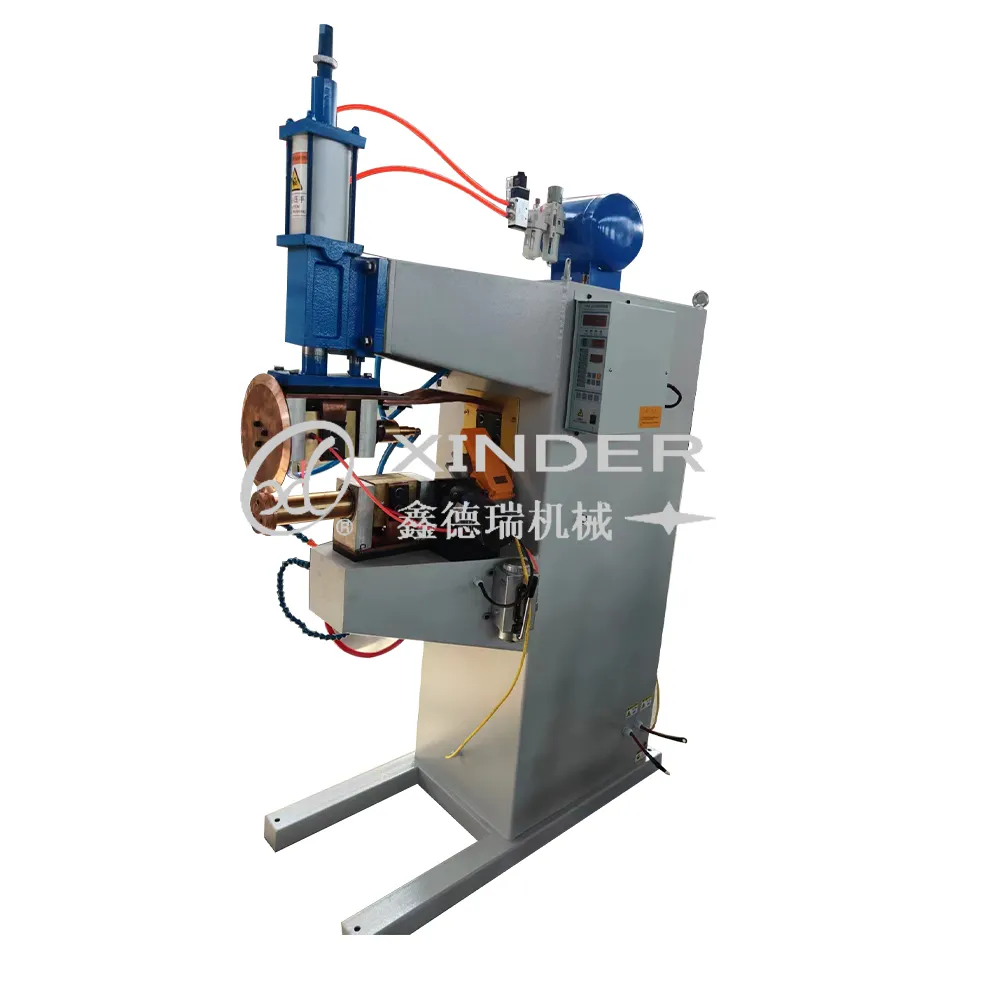
Pneumatic Rolling Welding Machine